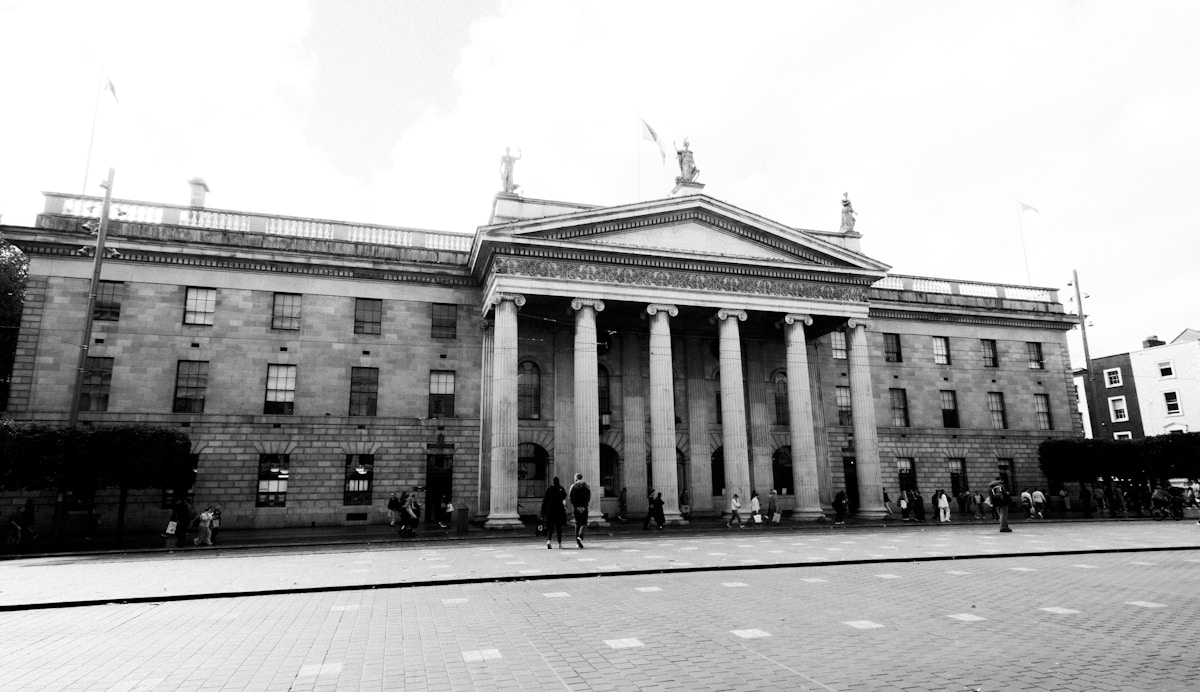
The General Post Office on O’Connell Street is the spiritual centre of modern Ireland. From its steps on Easter Monday 1916, Patrick Pearse read the Proclamation of the Irish Republic, and for six days the GPO became the headquarters of the Rising before being shelled into ruin.
The bullet holes are still in the columns. So is the proclamation, on the wall inside, almost casually, like it is just another notice. Growing up around it, you learn very early that big history can be a building you walk past on the way to the bus.
Before Easter Week
Long before 1916, the General Post Office was one of Dublin’s great civic buildings. Opened in 1818 on Sackville Street, now O’Connell Street, it was designed to project confidence, order and imperial administration. That symbolism is exactly what made it such a powerful target for the Irish Volunteers and the Irish Citizen Army during the Easter Rising.
By choosing the GPO as headquarters, the rebels were not simply occupying a useful building. They were taking over the communications heart of the city and turning a monument of British rule into the stage for a declaration of Irish independence.
The Proclamation
On Easter Monday, 24 April 1916, Patrick Pearse stood outside the GPO and read the Proclamation of the Irish Republic. The words announced that Ireland was a sovereign nation and named the signatories who were prepared to die for that claim: Thomas Clarke, Seán Mac Diarmada, Thomas MacDonagh, P. H. Pearse, Éamonn Ceannt, James Connolly and Joseph Plunkett.
The reading itself was not met by huge crowds or instant national celebration. Many Dubliners were confused, irritated or frightened. But the act became one of the defining images of modern Irish history: a small group claiming the right to self-determination from the steps of one of the city’s most recognisable buildings.
Headquarters of the Rising
Inside the GPO, the rebel leadership attempted to coordinate the wider Rising. James Connolly, already wounded during the week, helped direct military decisions from within the building. Pearse, Plunkett, Clarke and other leaders moved through rooms that had been turned from public offices into command posts, medical spaces and defensive positions.
The building’s central location gave the rebels visibility, but it also made them vulnerable. British forces gradually surrounded the city centre, and artillery fire from positions around Dublin began to make the GPO increasingly impossible to hold.
Fire, Shelling and Evacuation
As the week went on, Sackville Street was devastated. British shelling set buildings alight, and the GPO itself began to burn. Smoke, heat and collapsing interiors forced the leaders to accept that remaining inside would mean death without military purpose.
On Friday evening, the garrison evacuated through side streets, eventually taking shelter in nearby Moore Street. The move from the grand façade of the GPO to the cramped houses of Moore Street marked the collapse of the rebels’ central position, but not the collapse of the idea they had proclaimed.
Surrender and Aftermath
From Moore Street, Pearse issued the order to surrender on Saturday, 29 April, hoping to prevent further civilian deaths. The Rising had failed militarily, and much of central Dublin lay in ruins. Yet the executions that followed changed public opinion dramatically, turning defeat into a political awakening.
Because the GPO had been the place where the Republic was publicly declared, it became inseparable from the memory of the Rising. The building was no longer only a post office. It became a national symbol of sacrifice, rebellion and the unfinished argument over Irish freedom.
Legacy Today
The rebuilt GPO still carries the marks of 1916. Bullet holes remain visible in its columns, and the building now houses exhibitions and memorials that connect visitors to Easter Week. For Dubliners, it is both an everyday landmark and a place where the city’s history suddenly becomes impossible to ignore.
Its significance is not just architectural or military. The GPO matters because it gave the Rising a public face. It is where the idea of an Irish Republic was spoken aloud in the middle of the capital, and where a doomed rebellion became part of the foundation story of the modern Irish state.