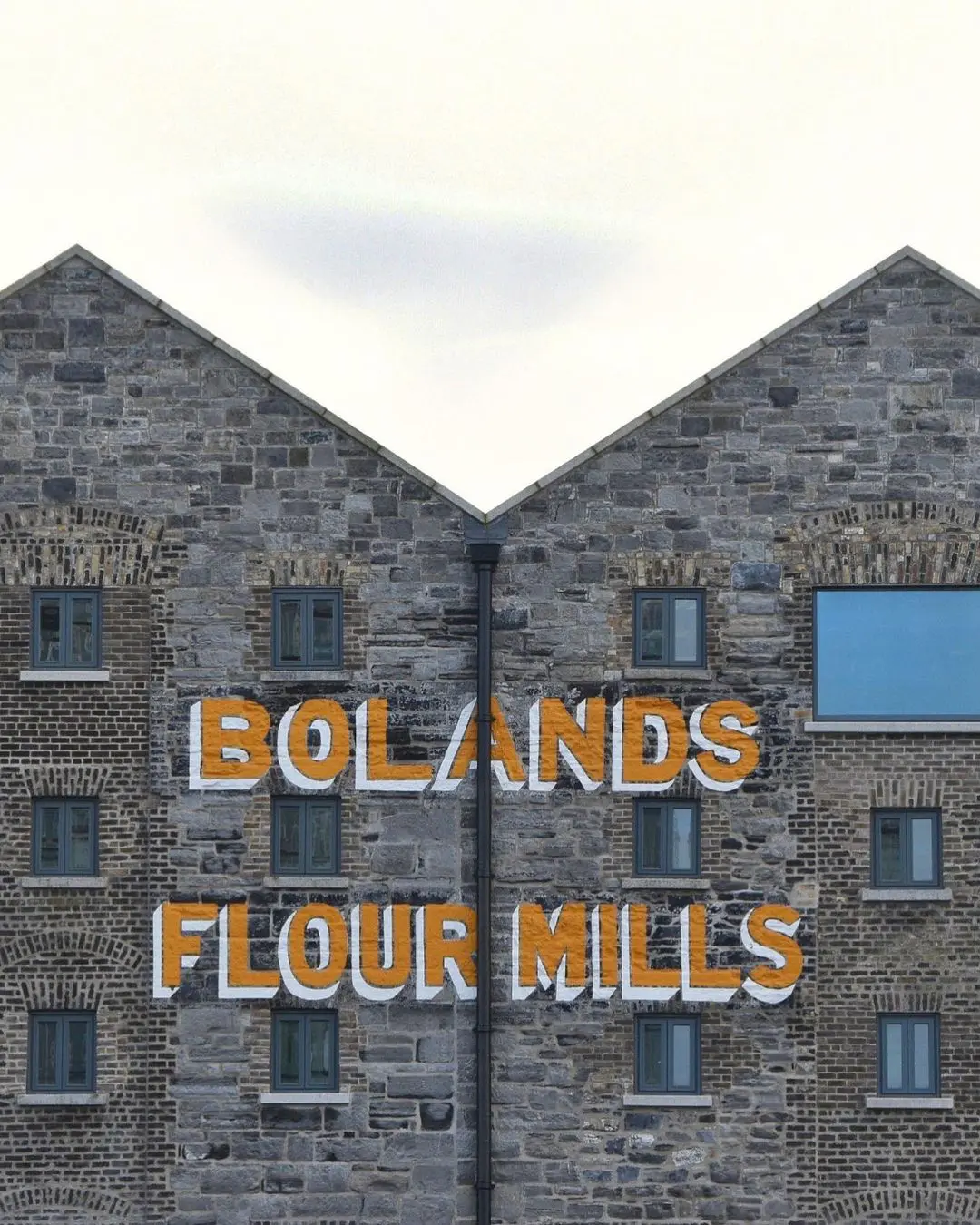
Boland’s Mill, sitting on the south bank of the Grand Canal Dock, was one of the most strategic positions seized during the 1916 Easter Rising. Commanded by Éamon de Valera, the 3rd Battalion of the Irish Volunteers occupied the mill to control the railway line into Westland Row and the approach from Dún Laoghaire — exactly the route British reinforcements were marching from.
Walking past the rebuilt mill on the way to school every day made history feel less like a textbook and more like the floor under your feet. The original silos are gone, but the memory the area carries is not.
Before the Rising
By 1916, Boland’s Mill was already a Dublin landmark — a six-storey flour mill on Grand Canal Street with a smaller bakery and granary complex strung along the canal and the Great Southern & Western Railway line. It was tall, it was solid, and it sat on top of every artery a British army would need to use to march into the city from the south. For Éamon de Valera, commandant of the 3rd Battalion of the Irish Volunteers, that geography was the entire point.
The 3rd Battalion’s assignment in the Rising was to hold the south-eastern approach to the city — a wedge stretching from Mount Street Bridge through Beggar’s Bush Barracks and down toward the railway line at Westland Row. Boland’s Mill was chosen as battalion headquarters not because it was the strongest single building, but because from its upper floors a small force could see, signal between, and support every other outpost at once.
Easter Week, 1916
On Easter Monday, around 130 Volunteers marched into the mill complex and got to work fortifying it. Windows were sandbagged, internal stairs were barricaded, and a tricolour was hoisted above the roofline. De Valera famously also ran up a green flag on a nearby empty distillery tower, hoping British gunners would waste artillery on a building no one was in. They did.
The defining moment of the area came on Wednesday, 26 April, at Mount Street Bridge — a few hundred metres from the mill. A handful of Volunteers in two terraced houses pinned down the Sherwood Foresters as they marched in from Dún Laoghaire, inflicting some of the heaviest British casualties of the entire week. The Foresters took the bridge, but at a cost that shaped how the Rising would be remembered.
At the mill itself the fighting was tense rather than constant. British troops shelled the area, gunboats on the Liffey added fire from the north, and snipers worked on both sides. De Valera reportedly slept very little, moving between posts to keep men focused as rumours and exhaustion set in. The garrison held its ground all week without being overrun.
The Surrender
By Sunday, 30 April, Patrick Pearse’s order to lay down arms had reached the outposts. De Valera, after some hesitation and verification, marched his men out of Boland’s Mill and surrendered. He was court-martialled and sentenced to death, but his sentence was commuted — a decision that would change Irish history more than the Rising itself.
Legacy
The original Boland’s Mill was demolished and partly rebuilt over the decades, and the Grand Canal Dock area around it has been transformed into a glass-and-steel tech quarter. But the silos that survive, the plaques on Mount Street, and the names of the buildings still anchor the district to that week in 1916.
Walking past the rebuilt mill on the way to school every day made history feel less like a textbook and more like the floor under your feet. The original silos may be gone, but what the area carries is not.